
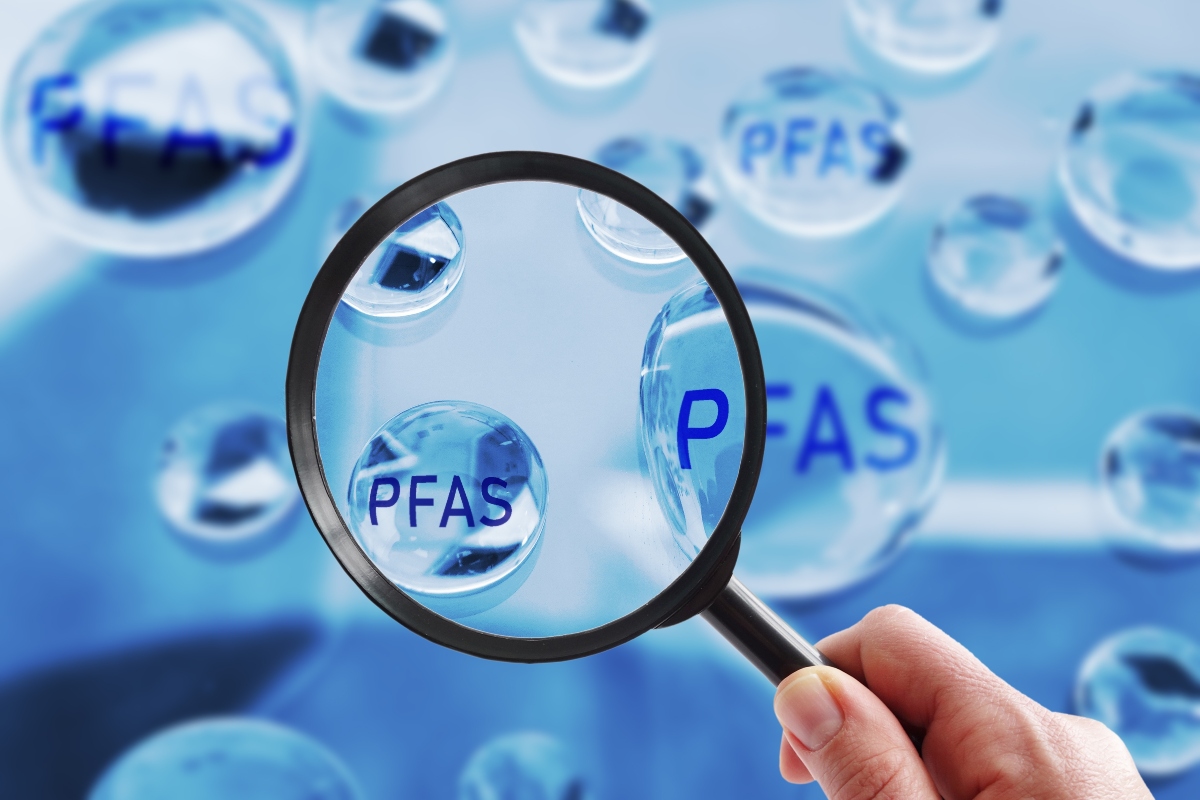
PFAS are gaining increasing attention in discussions about paper straws and sustainable packaging, but their presence extends far beyond these visible examples. These chemicals are widely used in everyday products, including takeout food wrappers, salad bowls, nonstick cookware, and even microwave popcorn bags, making them far more pervasive than many realize.
What Are PFAS?
Per- and polyfluoroalkyl substances (PFAS) are a large group of over 12,000 manmade chemicals (ScienceDirect). First introduced in the 1940s, they remain widely used today due to their resistance to grease, oil, water, and heat. These properties make them valuable in applications such as food packaging, paper and plant-based straws, stain-resistant textiles, nonstick cookware, and firefighting foam (U.S. Food & Drug Administration [FDA]).
PFAS are often referred to as “forever chemicals” because they do not break down in the environment or the human body. This persistence is due to their strong carbon-fluorine bond, which is one of the strongest in nature (Yale Office of Sustainability). As a result, PFAS accumulate over time and have been detected at low levels in the blood of people worldwide.
Health and Environmental Concerns
Certain PFAS compounds have been linked to serious health risks. Two of the most studied compounds are perfluorooctanoic acid (PFOA) and perfluorooctane sulfonate (PFOS), both of which are classified as carcinogens. According to the American Cancer Society, exposure to PFAS has been associated with increased risks of tumors in the liver, testicles, mammary glands, and pancreas.
While newer “short-chain” PFAS compounds, such as perfluorobutanoic acid (PFBA) and perfluorobutanesulfonic acid (PFBS), are considered less toxic and leave the body more quickly, the U.S. EPA notes they may still pose similar health risks (EPA Toxicity Assessment for PFBS).
From a regulatory standpoint, there has been progress. In February 2024, the FDA announced that grease-proofing PFAS used in paper and paperboard food packaging can no longer be sold in the United States. This was an important step forward in reducing exposure.
The Waste Challenge: PFAS in Landfills
Despite regulatory progress, PFAS-containing products continue to enter landfills, creating a significant downstream challenge. As these materials degrade, PFAS can leach into landfill leachate, potentially entering municipal treatment systems and, ultimately, waterways.
This raises a critical question for our industry: how do we effectively treat leachate to prevent PFAS from entering the broader environment?
Treatment Technologies for PFAS Removal
Several technologies are available to treat PFAS in water and waste streams, each with distinct advantages and limitations. Selection depends on site-specific conditions, water chemistry, regulatory requirements, and lifecycle costs. In many cases, a treatment train approach is required to achieve effective removal and manage residuals.
Granular Activated Carbon (GAC): GAC is a widely used and proven technology, particularly effective for long-chain PFAS such as PFOA and PFOS. PFAS compounds adsorb onto the carbon surface, though performance can be reduced by natural organic matter and competing contaminants. While spent carbon can sometimes be regenerated off-site, handling and disposal considerations remain.
Ion Exchange (IX): Ion exchange resins selectively bind PFAS, often providing higher capacity and faster kinetics than GAC. IX is generally more effective for short-chain PFAS, though performance depends on resin type and water chemistry. These systems have a smaller footprint but higher upfront costs, and regenerant or spent media must be managed.
Foam Fractionation (FF): Foam fractionation, or air-induced foam separation, exploits PFAS affinity for air-water interfaces. Air bubbling concentrates PFAS into a removable foam layer. It is most effective for long-chain compounds and is often used as a pre-treatment step; additional treatment is typically required for short-chain PFAS and residuals.
Reverse Osmosis and Nanofiltration (RO/NF): Membrane systems can achieve very high PFAS rejection (often >99%) and are commonly used as polishing steps. However, they entail higher capital and operating costs and produce a concentrated reject stream that requires further management.
Residuals Management and Destruction: All separation technologies generate concentrated residuals (e.g., spent media, brine, membrane concentrate) that must be treated or disposed of. Incineration is commonly used, though concerns remain regarding the completeness of destruction. Emerging technologies such as supercritical water oxidation, electrochemical oxidation, and plasma processes aim to destroy PFAS but are still in development for commercial use.
Emerging and Hybrid Approaches: New adsorbents (e.g., modified clays, biochar, advanced polymers) and hybrid systems are being explored to improve performance and address a broader range of PFAS compounds.
In practice, effective PFAS management typically relies on a multi-barrier treatment approach to meet regulatory limits while addressing residuals and long-term costs.
Looking Ahead
As regulatory pressure from state and federal agencies continues to increase, managing PFAS will become an even more critical priority for waste and water systems. Evaluating treatment technologies and understanding their long-term cost and performance implications will position organizations to better support compliance and protect environmental and public health.
U.S. Water is well-positioned to support clients through this evolving landscape by evaluating site-specific conditions, comparing treatment technologies, and identifying cost-effective, compliant solutions. Contact us to discuss how we can support your facility by providing expert feedback during the design process, supporting pilot testing, and delivering ongoing operation and optimization services to help ensure treatment systems perform reliably and meet regulatory requirements.