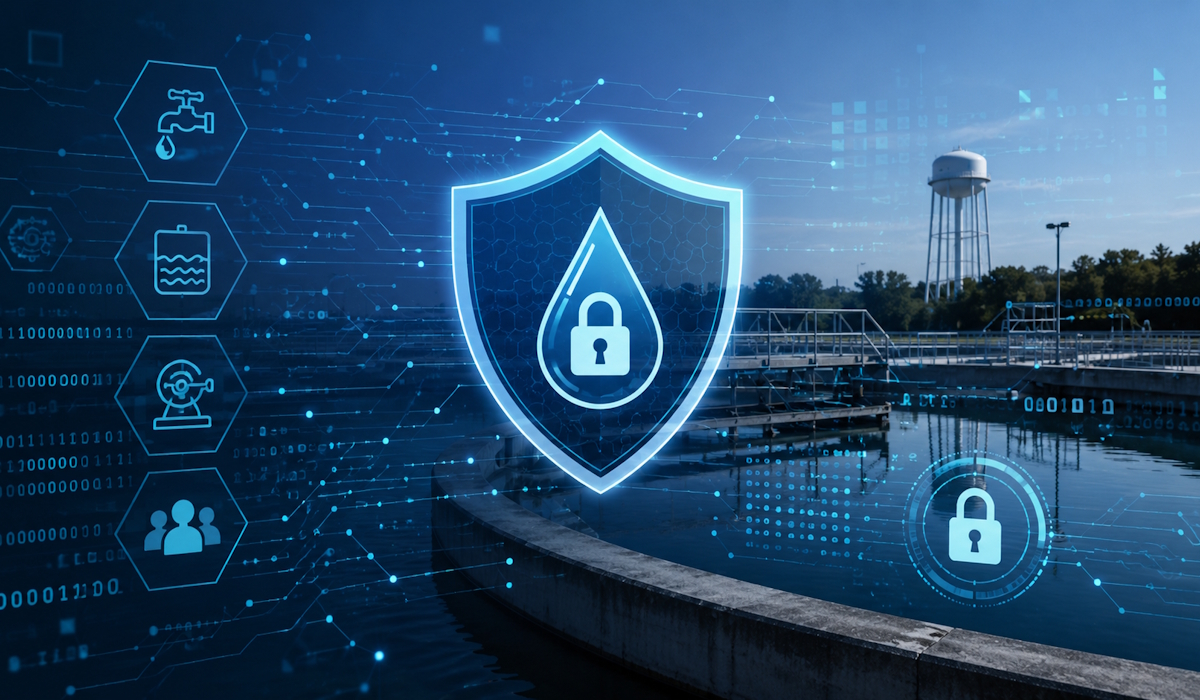
Cybersecurity has become an increasingly important operational concern for drinking water and wastewater utilities. Recent attacks on municipal water systems have shown that cyber incidents can extend beyond traditional information technology systems and interfere with the operational technology that controls pumps, treatment processes, communications, and other critical infrastructure.
In response, U.S. Senators Adam Schiff of California and Amy Klobuchar of Minnesota introduced the Water Cyber Shield Act of 2026 on August 10. The proposed legislation would expand the U.S. Environmental Protection Agency’s authority to address cybersecurity risks within the water and wastewater sector while providing additional resources to help utilities strengthen their defenses.
The legislation comes amid heightened concern about attacks against water infrastructure. More than 30 community water systems were reportedly targeted during a recent series of coordinated cyberattacks, with some utilities experiencing disruptions to automated controls. In several cases, operators maintained safe service by switching to manual operations, reinforcing both the vulnerability of operational technology and the importance of effective emergency response planning.
What the Water Cyber Shield Act Would Do
EPA already serves as the federal Sector Risk Management Agency for the water and wastewater sector, but the proposed legislation would give the agency additional authority to oversee cybersecurity preparedness. The bill would amend both the Safe Drinking Water Act and Clean Water Act and establish a more comprehensive federal framework for addressing cyber risks.
For drinking water systems, cybersecurity risks to electronic and automated systems would become part of existing Risk and Resilience Assessments. Emergency Response Plans would also need to identify measures that systems maintain or intend to implement to protect against cyber threats. EPA would be authorized to conduct cybersecurity assessments of a representative sample of public water systems and could require corrective action when it identifies significant deficiencies.
The legislation would establish similar requirements for covered wastewater treatment systems, including Risk and Resilience Assessments, Emergency Response Plans, cybersecurity assessments, and baseline standards. Smaller wastewater systems would be exempt from certain requirements.
Importantly, the proposal calls for a tiered approach rather than a one-size-fits-all standard. Requirements could differ according to the size, risk, and capacity of individual systems. Water-sector representatives would also help develop the standards, and sensitive cybersecurity information submitted to EPA would be protected from disclosure.
Potential Benefits for Municipal Utilities
For municipalities, one of the most significant provisions may be financial assistance accompanying the proposed requirements. If passed, the bill would authorize an additional $300 million for the Drinking Water State Revolving Fund and another $300 million for the Clean Water State Revolving Fund, dedicated specifically to cybersecurity needs.
That funding could be especially valuable for smaller, resource-constrained municipalities. Cybersecurity improvements can require investment in network architecture, equipment, software, monitoring, assessments, employee training, and specialized technical expertise. The proposed legislation prioritizes assistance for smaller systems and those facing greater risks, rather than imposing new expectations without corresponding resources.
The potential benefit extends beyond regulatory compliance. A successful cyberattack can interrupt operations, damage equipment, require costly recovery efforts, expose sensitive information, or potentially affect water quality. Those expenses can ultimately reach municipal budgets and ratepayers. The legislation therefore treats cybersecurity as an issue involving not only national security and public health, but also water affordability.
Preparing for a More Cyber-Resilient Future
The Water Cyber Shield Act remains proposed legislation, so its requirements could change as it moves through Congress. Nevertheless, its introduction signals the growing federal focus on cybersecurity in the water sector.
Municipal utilities do not need to wait for new regulations to begin improving their preparedness. Reviewing SCADA and other operational technology, identifying unnecessary internet exposure, strengthening remote access, updating passwords and access controls, maintaining reliable backups, documenting manual operating procedures, and incorporating cyber incidents into emergency response planning can all contribute to greater resilience.
For municipalities that partner with U.S. Water, cybersecurity can also be approached as part of overall operational preparedness. Our experience operating and supporting water and wastewater facilities gives us an important understanding of how treatment processes, SCADA systems, operators, emergency procedures, and technology intersect. We can work with municipal customers to identify operational vulnerabilities, strengthen procedures, improve documentation and emergency preparedness, coordinate with technology and cybersecurity specialists, and help facilities prepare for evolving regulatory expectations.
Cybersecurity is increasingly becoming part of responsible water and wastewater system management. Whether or not the Water Cyber Shield Act is ultimately enacted in its current form, its direction is clear: protecting critical water infrastructure will require greater attention, stronger planning, and continued investment. U.S. Water is prepared to help our municipal partners navigate that changing environment while keeping the primary mission where it belongs, on providing safe, reliable, and resilient water and wastewater services.
Sources
- NEWS: Sens. Schiff, Klobuchar Release Comprehensive Cybersecurity Bill in Wake of Recent Cyberattacks on Water Infrastructure
https://www.schiff.senate.gov/news/press-releases/news-sens-schiff-klobuchar-release-comprehensive-cybersecurity-bill-in-wake-of-recent-cyberattacks-on-water-infrastructure/ - Cyberattacks targeting U.S. water systems prompt renewed focus on utility cybersecurity | WaterWorld
https://www.waterworld.com/water-utility-management/news/55395154/cyberattacks-targeting-us-water-systems-prompt-renewed-focus-on-utility-cybersecurity
Related
Cyber Threats Against Water Utilities Continue to Grow
https://www.uswatercorp.com/cyber-threats-against-water-utilities-continue-to-grow/